Introduction
The purpose of this thesis was the aerodynamic and aeroacoustic analysis of airfoil with various types of serrated trailing edge. This type of design arose from the study of owl’s wings and aims at the optimization of modern turbomachinery’s aeroacoustic behavior.
In total, seven geometries of blades were designed (based on the NACA0012 symmetric airfoil): one basic geometry with an unchanged trailing edge, three geometries with a serrated trailing edge of height 2h equal to 2 cm and three more in which the height of the serration equals 1 cm. The aforementioned geometries were examined by means of computational methods using two computational fluid analysis softwares: Ansys Fluent, which is a commercial package commonly used in such problems, and OpenFoam, which is an open source software. The final aim of the dissertation was, on the one hand, to compare the results of these softwares with the existing scientific literature, and on the other hand to compare the capabilities of the two softwares and to evaluate the possible use of OpenFoam as an alternative to Fluent.
Simulation Setup
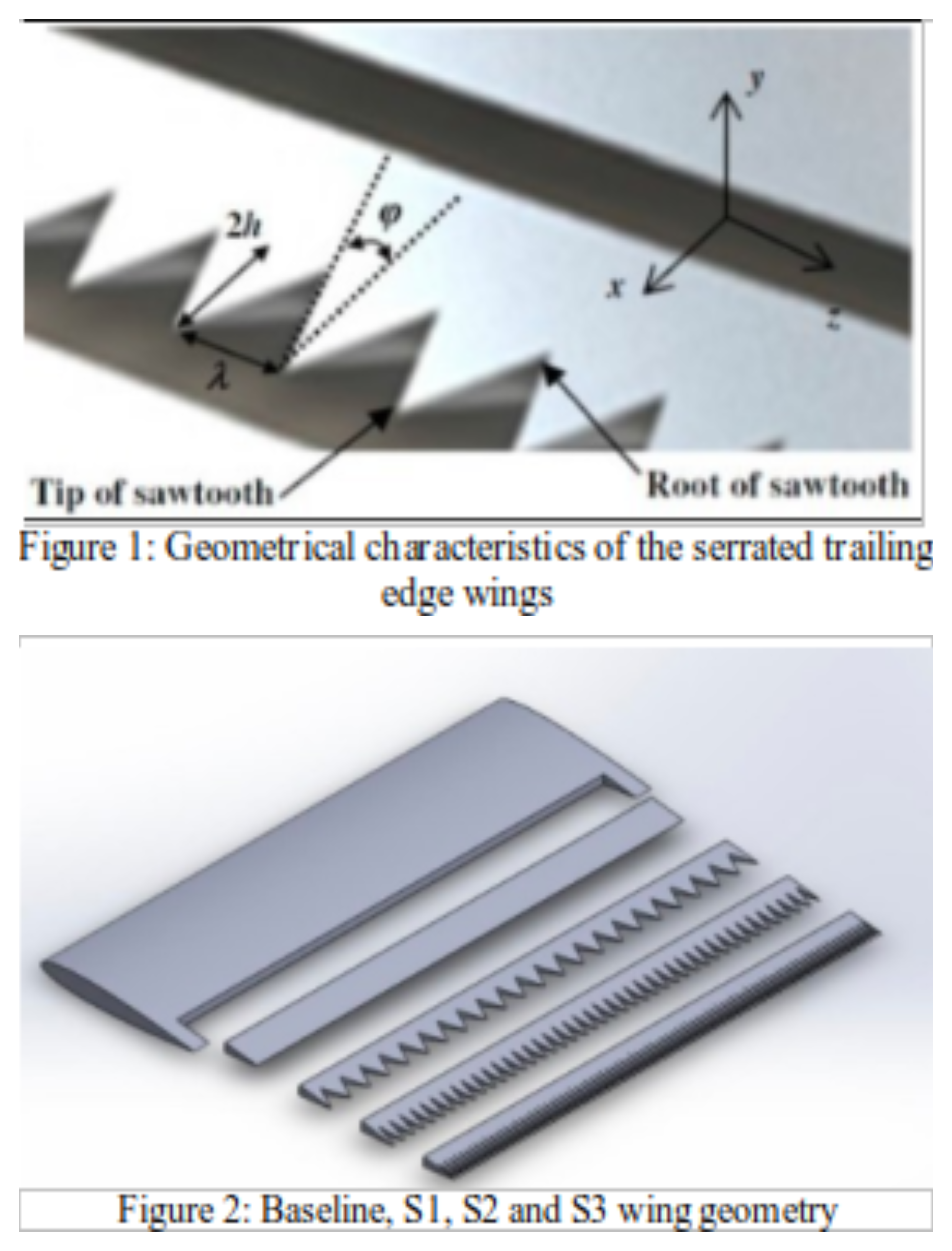
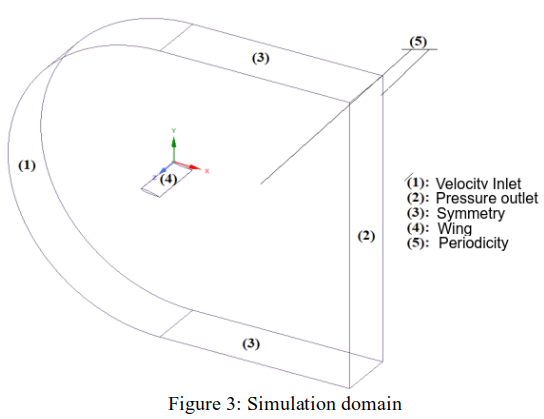
In all the analyses carried out, the basic airfoil was chosen to be a symmetric NACA0012 and the wings that were designed had a chord length of 15cm. The type of the serrations on the trailing edge, which were designed according to the work of chong et al[1], are in each case an integral part of the wing and not an addition. Figure 1 depicts the type and basic characteristics of these serrations. In total 7 scenarios, that are shown in figure 2, were studied. The first scenario is the reference scenario with the airfoil being unchanged, while scenarios S1, S2, S3 are characterized by a tooth height equal to 2 cm, a wavelength of 0.49 cm, 0.85 cm and 1.87cm and angle φ 7°, 12°, 25° respectively. Finally,in S1*, S2* and S3* the height teeth has been reduced to 1 cm while the corresponding wavelengths have been maintained unchanged, increasing the angle φ to 14°, 24°, 50° respectively.
The Reynolds number of the simulations equals 200000 (fully turbulent flow) using as reference length the length of the chord of the unchanged blade. Regarding the turbulence model, k-omega SST was chosen mainly due to its higher accuracy in the modelling of the boundary layer of the blade, a phenomenon of major importance for the realization of the aero-acoustic analysis.
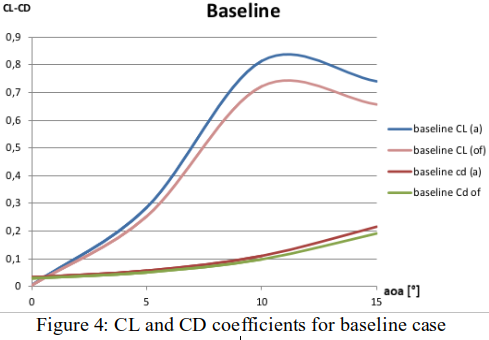
The simulation configuration and the boundary conditions are shown in Figure 3. More precisely, the wing is enclosed in a computational mesh in which a symmetry condition has be defined on the upper and lower walls, while on the left and right periodicity has been set. Note that the aerodynamic analyses were performed for a range of angles of attack α=[0°,15°], while the aero-acoustic analyses have been carried out for the case of angle of attack α=10°.
Aerodynamic Results
In this section some of the aerodynamic results are presented. Specifically, the lift and drag coefficients of the baseline, S1, S1*, S3 and S3* cases are showcased in figures 4 to 8. While no aerodynamic data for exactly the studied wings were available in the scientific literature, the numerical results were evaluated with similar cases, and their general behaviour was compared with the expected
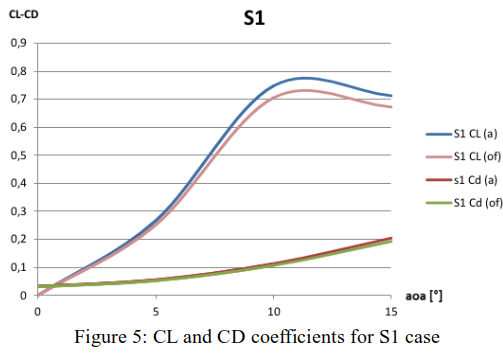
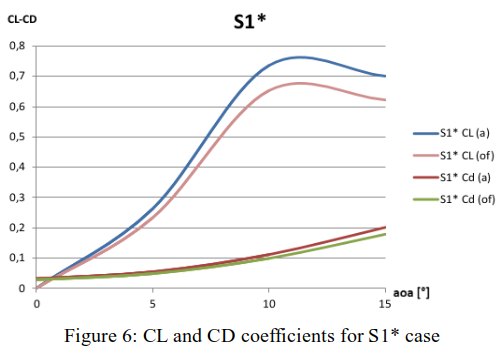
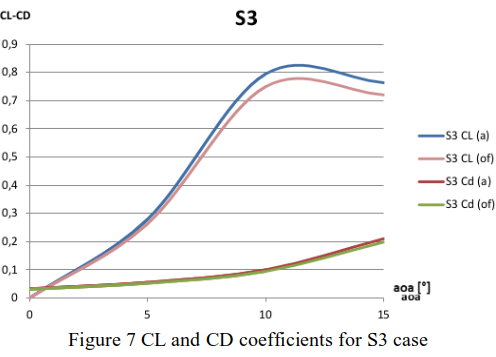
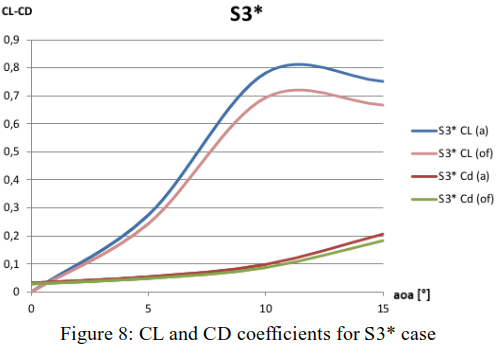
The above results closely match those of the existing literature. In particular, based on experimental measurements [2], [3] it was observed that for the case of a wing based on a symmetric airfoil NACA0012, the implementation of a serrated trailing edge leads to a reduction of the lift coefficient for higher angles of attack, while presenting minimal changes for lower angles.
Such a conclusion can be drawn both from the results of the analyses carried out in Fluent as well as those of OpenFoam. By comparing the graphs, it is observed that for an angle of attack up to 9° the lift coefficient does not change significantly when using serrations (something mentioned in the literature too). For largers angles it is observed that the presence of serrations leads to a noticeable reduction of the lift coefficient compared to the baseline geometry, which increases for increased tooth height and decreasing angle φ.
In the case of Fluent, a greater decrease of the lift coefficient is noted for the case of serrations where 2h=2cm and φ=7° (~9.5%), while the lowest is observed for the case where 2h=1cm and φ=14° (~0.5%). In OpenFoam, a larger reduction is again observed for the case of teeth where 2h=2cm and φ=7° (~6%), while the smallest is noted for the case where 2h=1cm and φ=24° (~0.5%), while the deviation of the coefficients with respect to the base case occurs a little earlier than 9°. Additionally, in the case of the drag coefficient, the addition of the serrations leads to it's minor increase, something that was mentioned in the linked reasearch papers and is present in the simulation of both the softwares.
Finally,the results of both softwares exhibit a similar behaviour. However, there is a consistent divergence in the numerical values of those results, especially at larger angles of attack, which amplifies in the case of the lift coefficients. In general, OpenFoam has led to systematically reduced values, by 7%-12% for Cl and 1%-3% for Cd when compared to those of Fluent.
Aeroacoustic Results
Finally, the aeroacoustic results are presented. It is noted that the position of the observer point was set at a distance x=8C where C is the length of the wing chord. Figure 9 present the acoustic results of experiments [4] performed on geometries that fully correspond to the first four scenarios of this dissertation (the baseline scenario and cases S1,S2,S3). Additionally, figures 10 and 11 showcase the Sound Power Level given by the coupled simulation from the two softwares.
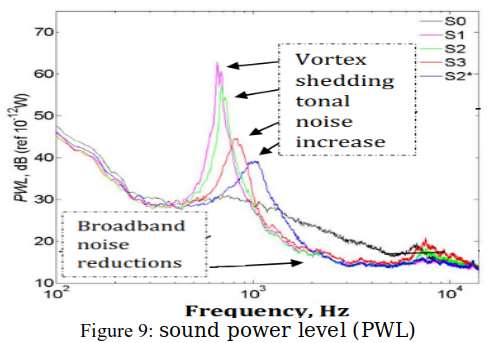
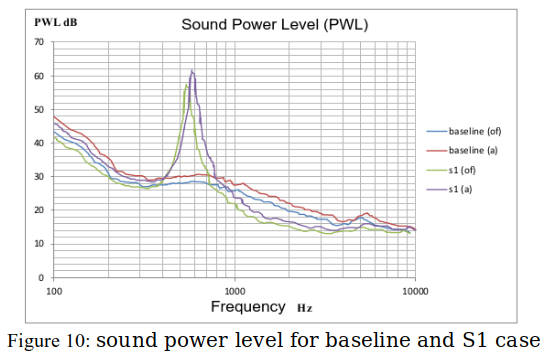
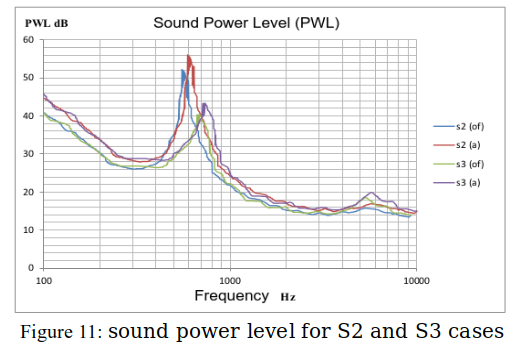
The general trend of the results is consistent with the existing literature. In particular, it is observed that the presence of serrations leads to a reduction in the levels of broadband noise at high frequencies (~5-6 dB). Specifically, with an increase in λ, a decrease in power intensity is noted at this frequency range. However, this reduction results in a significant increase in noise at a narrowband tone. According to the literature this is due to the spinning of the fluid in the openings of the serrated morphology of the vanishing edge.
Regarding the effect of the length of the teeth, it is observed that an increased height leads to an increased reduction in acoustic power levels. This is because longer the indentations affect the flow and the existing boundary layer for a longer period of time However, shorter tooth height leads to a reduction in acoustic power levels at lower frequencies. As mentioned, the source of this noise is mainly the fluid's agitation in the blunt openings of the serrations. Therefore, a decreased height of the indentations, leads to a decreased available surface in which the solid-fluid interaction can occur.
Finally, the results of the two software present a similar form. However there is a discrepancy in the numerical values. As in the case of aerodynamic analysis, OpenFoam tends to underestimate the intensity levels of the acoustic power levels and this is likely to be a consequence of underestimating the levels of turbulence levels in the rotor field.
Conclusion
The purpose of the thesis was the numerical study of a novel design of wings, in order to, on the one hand, understand the complex physical phenomena governing the aero-acoustics of wings, and on the other hand to verify the capability of modern computer software packages in approximating the experimental data or theoretical models. Given that this discipline is characterised by a multitude of possible research topics, the present work focused on the effect of serrations on the blade trailing edge (based on the morphology of owl wings) on their aerodynamic and aero-acoustic behaviour. Two software packages were chosen to complete analyses: ANSYS' Fluent and OpenFoam, an open source software. The main objective was to compare the results of the analyses of these two softwares both with each other and with the existing scientific literature. . Since OpenFoam has not been widely used to conduct aeroacoustic wing analyses, there was a strong interest in evaluating its capabilities against a commercial program.
For the simulations a total of seven blade geometries were designed: one baseline case without any modifications, three cases in which the serrations had a height of 2 cm and three in which the height was 1 cm. Those seven scenarios were examined both aerodynamically and aeroacoustically. In order to carry out the analyses, for Re = 100000, the turbulence model chosen was k-ω SST. The aerodynamic study was carried out for a range of angles of attack α=[0°,15°], where the variation of Cl and Cd coefficients were examined, and then for α=10°, the CP coefficient , the velocity distribution and the the aeroacoustic behaviour of the blades were studied.
Regarding the aerodynamics of the wings, it was found that the results of the analyses of both software programs agree with the literature. In particular, the existence of indentations leads to a reduction in the lift coefficient, which becomes more pronounced as the angle of indentation φ decreases. Reductions of up to ~10% were observed. In addition, the coefficient of drag does not show any significant variations in relation to the characteristics of the indentations.
Finally, regarding the results of the aeroacoustic analyses, it is observed that the results of both softwares closely match those found in the literature. In particular, indentations with longer length and shorter angle φ lead to a greater reduction in the levels of the generated sound (up to 7dB) of broadband character, causing a simultaneous increase in sounds of a small amplitude frequency range. On the other hand, serrations with a smaller height do not lead to a major increase in this sound, but present a limitated capitalize in reducing the broadband sound.
[1] Chong, T.P.; Joseph, P.F.; Gruber, M. Airfoil Self Noise Reduction by Non-Flat Plate Type Trailing Edge Serrations. Appl. Acoust. 2013, 74, 607–613.
[2] Liu, Xiao & Kamliya Jawahar, Hasan & Azarpeyvand, M. & Theunissen, R.. (2015). Aerodynamic and Aeroacoustic Performance of Serrated Airfoils. 10.2514/6.2015-2201
[3] Liu , X . , Kamliya Jawahar, H., Azarpeyvand, M., & Theunissen, R. (2017). Aerodynamic performance and wake development of airfoils with serrated trailing-edges. AIAA Journal,55(11),3669-3680. https://doi.org/10.2514/1.J055817
[4] Alexandros Vathylakis, Reduction of broadband trailing edge noise by serrations, (A dissertation submitted for the degree Doctor of Philosophy), MAY 2015